








-
AllAnytime Fitness Gym Art Blog Bus Fares Bus Service Business Business Expo C2C Care Care Home Charity Children Christmas Cinema City Status Cliffs Pavilion Cliffs Pavilion Review College Community Competition Construction Coronation Coronavirus Design Easter Education Electoral changes Leigh on sea Employment Emsella Chair Environment Essex & Suffolk Water News Essex Police Essex Wildlife Trust News Events Family Fun Fashion Festival Film Finance Fitness Food Food & Drink Foulness Bike Ride Fresh Face Pillow Company Gardening General Election Hair & Beauty Halloween Harp Havens Havens Hospice Havens Hospices Havens Hospices Health & Fitness Health & Beauty Health & Fitness Healthwatch Southend Historicaleigh History Holidays Housing Indian Indirock Jubilee Karen Harvey Conran Kids Kids Competitions Lazydays Festival Legal Leigh Art Trail Leigh Folk Festival Leigh Library Leigh Road Leigh Town Council Leigh Town Council Press Release Leigh on Sea Leigh on sea Folk Festival Leigh on sea Marathon Leigh on sea Town Council Leigh on sea man breaks marathon record Leigh on sea news Lifestyle Livewell Southend Press Release LoS Shop London Southend Airport Los Shop Marathon Mortgage Angel blog Mortgages Mughal Dynasty Music My Mortgage Angel MyLoS NHS News News Offers Palace Theatre Parenting Parking Pets Picture Of The Week Pier Politics Press Release Press Release Southend City Council Professional Property Property Of The Week RSPCA Ray Morgan Re:loved Recipes Recycling Restaurant Restaurant Review Restaurants Review Roads Rotary Club Royal Hotel Royal Visit SAVS Schools Seafront Shopping Shows & Music Review Shows & Music Shows & Music Review Southend Southend Airport Southend Borough Council Press Release Southend City Bid News Southend City Council Southend City Council Press Release Southend City Council Press Release Southend Community Safety Southend Hospital News Southend In Sight Southend In Sight Southend In Sight Press Release Southend on Sea Sport The One Love Project The Ship Hotel Theatre Theatre Blog Theatre Review Theatre review Transport Travel Travel Veolia Volunteer Weddings Whats On c2c
Progress continues on restoration of Southend's historic Kursaal
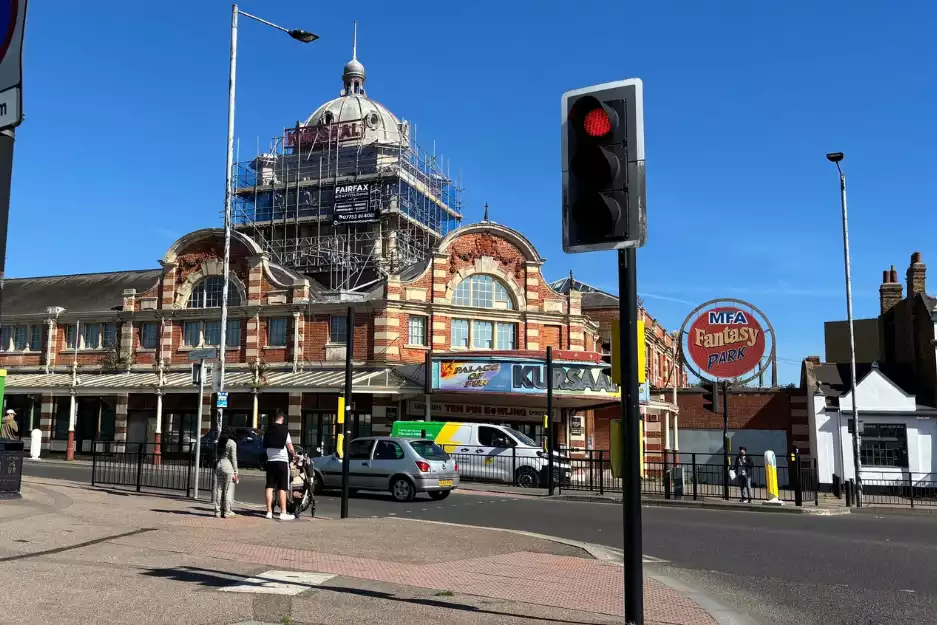
Visible progress is being made on one of Southend's most recognisable landmarks, with major external repair works now underway on the iconic Kursaal dome.
Scaffolding has been erected around the Grade II-listed building, allowing specialist repairs to begin as part of a wider programme aimed at safeguarding and restoring the historic seafront landmark.
The work follows the appointment of local leisure operator Star Amusements as leaseholder earlier this year. The restoration programme is being carried out in phases, with the immediate focus on stabilising the building, carrying out structural and heritage surveys and developing longer-term plans for its future.
Much of the work undertaken so far has taken place inside the building and has therefore been largely out of public view. The arrival of scaffolding and the start of repairs to the distinctive dome represent a more visible stage of the project.
Councillor Matt Dent, Cabinet Member for Business, Culture, Music and Tourism at Southend-on-Sea City Council, said:
"It's encouraging to see visible progress being made at the Kursaal following many years of uncertainty about the building's future.
"The Kursaal is an important part of Southend's heritage and a prominent feature of our seafront. These works represent a positive step towards securing the future of this historic landmark and bringing it back into active use.
"We welcome the progress being made by Star Amusements and look forward to seeing further developments as the restoration programme continues."
The Kursaal has been at the heart of Southend's leisure history for more than a century.
The site began life as the Marine Park, which was laid out in 1894. The Kursaal building was designed by architect George Sherrin in 1896 and constructed between 1898 and 1899, before the wider complex was completed and opened in 1901.
The name "Kursaal" comes from the German term for a public hall or meeting place at a spa resort. In Southend, the name became associated with a major entertainment complex designed to attract visitors to the growing seaside resort.
At its height, the wider Kursaal amusement park covered around 26 acres and featured a remarkable range of attractions, including a menagerie, music hall, funfair, shops, restaurants and other entertainment facilities. The building itself housed a circus, ballroom, amusement arcade, dining hall and billiard room.
The Kursaal was designed as a grand entrance to the Marine Park and quickly became one of Southend's principal attractions during the town's Edwardian-era expansion.
Its distinctive red-brick frontage, stone detailing and large glazed dome have since become an enduring part of Southend's seafront identity. Architect George Sherrin's work on the Kursaal is also considered significant, with the building regarded as one of his major works outside London.
The building was officially Grade II listed in 1994 in recognition of its special architectural and historic interest.
Although much of the original amusement park has disappeared or been redeveloped over the years, the Kursaal building survives as a reminder of the era when Southend was developing into a major seaside resort.
The building has been closed since 2020 and has faced an uncertain future in recent years. In May 2026, Southend-on-Sea City Council confirmed that the lease had been assigned to Remblance Leisure Limited, led by Star Amusements, with essential repairs and a phased restoration planned.
The current programme is intended to preserve the historic structure while supporting plans to return the Kursaal to active use as a leisure and entertainment destination.
For a building that has stood on Southend's seafront for more than 120 years, the latest repairs mark another chapter in the long history of one of the city's most recognisable landmarks.
ADD A COMMENT
Note: If comment section is not showing please log in to Facebook in another browser tab and refresh.