


















-
AllAnytime Fitness Gym Art Blog Bus Fares Bus Service Business Business Expo C2C Care Care Home Charity Children Christmas Cinema City Status Cliffs Pavilion Cliffs Pavilion Review College Community Competition Construction Coronation Coronavirus Design Easter Education Electoral changes Leigh on sea Employment Emsella Chair Environment Essex & Suffolk Water News Essex Police Essex Wildlife Trust News Events Family Fun Fashion Festival Film Finance Fitness Food Food & Drink Foulness Bike Ride Fresh Face Pillow Company Gardening General Election Hair & Beauty Halloween Harp Havens Havens Hospice Havens Hospices Havens Hospices Health & Fitness Health & Beauty Health & Fitness Healthwatch Southend Historicaleigh History Holidays Housing Indian Indirock Jubilee Karen Harvey Conran Kids Kids Competitions Lazydays Festival Legal Leigh Art Trail Leigh Folk Festival Leigh Library Leigh Road Leigh Town Council Leigh Town Council Press Release Leigh on Sea Leigh on sea Folk Festival Leigh on sea Marathon Leigh on sea Town Council Leigh on sea man breaks marathon record Leigh on sea news Lifestyle Livewell Southend Press Release LoS Shop London Southend Airport Los Shop Marathon Mortgage Angel blog Mortgages Mughal Dynasty Music My Mortgage Angel MyLoS NHS News News Offers Palace Theatre Parenting Parking Pets Picture Of The Week Pier Politics Press Release Press Release Southend City Council Professional Property Property Of The Week RSPCA Ray Morgan Re:loved Recipes Recycling Restaurant Restaurant Review Restaurants Review Roads Rotary Club Royal Hotel Royal Visit SAVS Schools Seafront Shopping Shows & Music Review Shows & Music Shows & Music Review Southend Southend Airport Southend Borough Council Press Release Southend City Bid News Southend City Council Southend City Council Press Release Southend City Council Press Release Southend Community Safety Southend Hospital News Southend In Sight Southend In Sight Southend In Sight Press Release Southend on Sea Sport The One Love Project The Ship Hotel Theatre Theatre Blog Theatre Review Theatre review Transport Travel Travel Veolia Volunteer Weddings Whats On c2c
Review of The Signalman By Lynn Carroll
Before I even took my seat I was mightily impressed by the stage set. A cutaway signal box with many props showing a homely little room complete with fireplace, kettle, books, lamps and so forth. To the left a very realistic video projection of a tunnel opening with train tracks filling the stage to the front and a fair way back into the tunnel. To the far left an array of realistic greenery covering an embankment.
This will be good, I thought to myself and sure enough the sound effects and further visuals did not disappoint. The noisome racket of an old time steam train complete with whistles and copious amounts of steam assailed our senses and could not have been bettered, in my opinion, on stage. More than once we were treated to this spectacle and something else at the tunnel entrance, I will say no more.
The opening scene began with an elderly signalman pottering around the outside of the signal box and alongside the tracks, seeing to his duties before entering his little room where he would spend his nights making sure the trains ran safely. Without giving too much away it is not long before he hears someone shouting, a gentleman on a rambling holiday who scrambles down the embankment and introduces himself.
A little suspicious at first the signalman then invites him into the signal box where they take tea and chat, from that point the story unfolds.
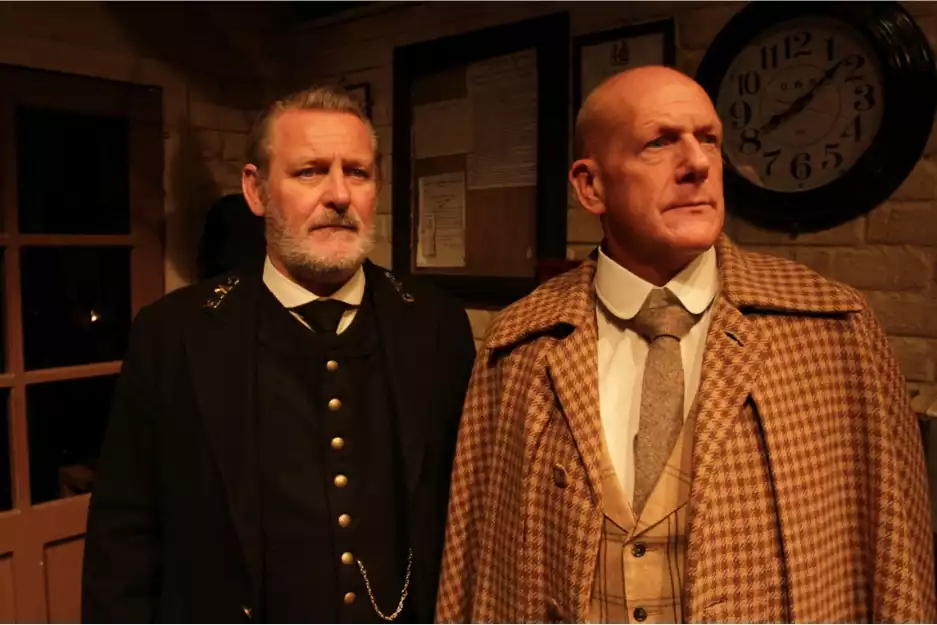
I could easily imagine I was watching two gentlemen from the Victorian era, pocket watch and costumes were spot on. On occasion I struggled to hear every word of dialogue but not enough to distract from my understanding of the plot.
Whilst acknowledging this was a Charles Dickens short story I found myself thinking it was maybe an early effort that lacked the depth of storytelling his later works would show. However, I realised I was being totally unfair to compare his written works to a short story play, like all book adaptations it will not satisfy as much as reading the words an author spends much time and passion in committing to their work. But being inquisitive I found that it was actually written in 1866, just four years prior to his death, and just one year after surviving the Staplehurst rail crash in June 1865. This traumatic event affected him deeply and influenced the theme of this story. In later life he became a member of the ‘Ghost Club’ and his interest in the supernatural increased. One might wonder how much of his personal experience went into this story as he was also known for blending fact and fiction quite seamlessly. Go along and see for yourself. It is not the type of story to have you jumping in your seat but you will certainly sense an aura of the supernatural.
ADD A COMMENT
Note: If comment section is not showing please log in to Facebook in another browser tab and refresh.